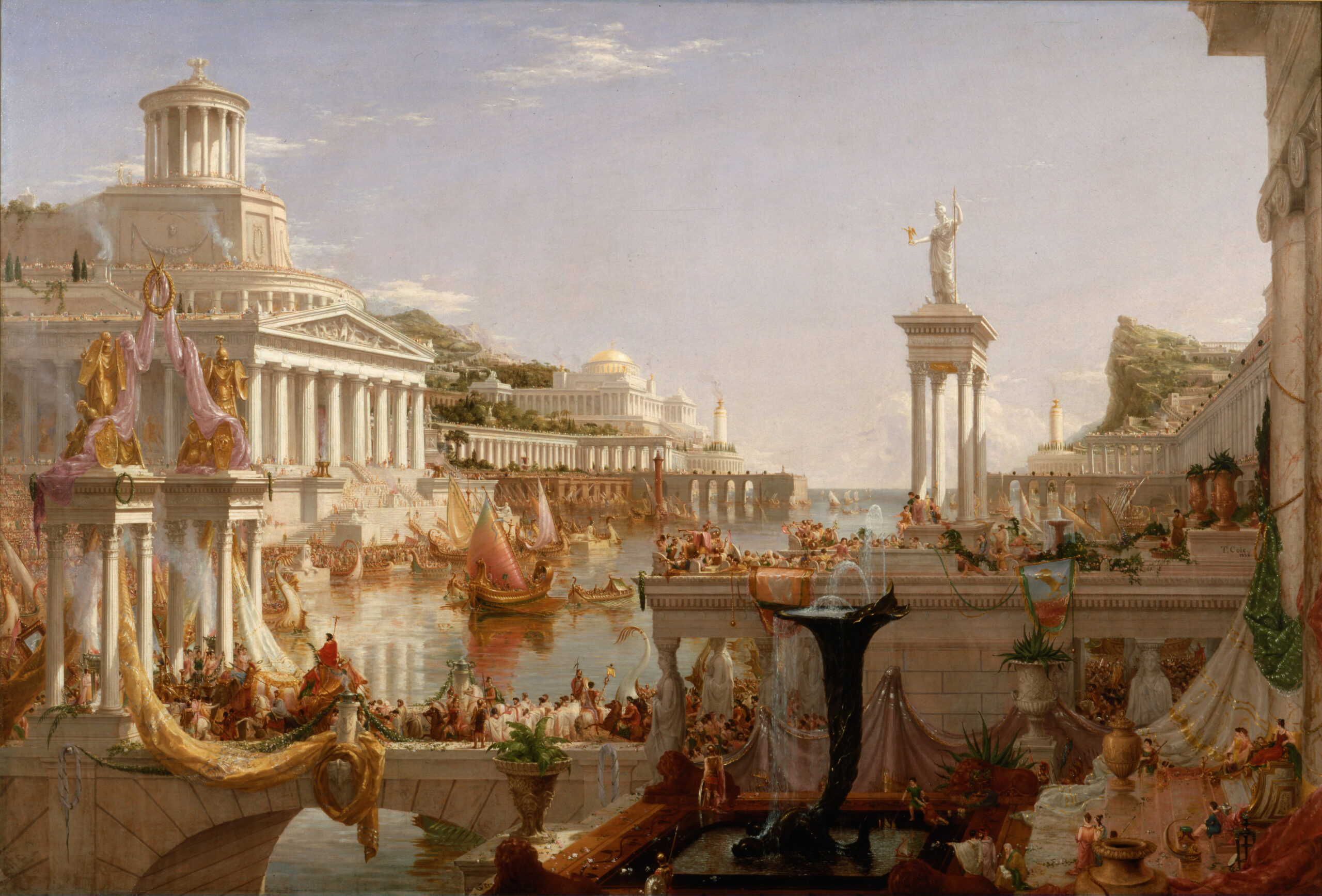
The Course of Empire, is a series of paintings (1833-1836) by the American landscape artist Thomas Cole (1801-1848). In the artworks, he depict’s the course of human civilisation and its rise and fall using the metaphor of the sun in the sky. From civilisation’s primitive beginnings to its great heights, decay and final destruction.
In painting the series, Thomas Cole hoped to produce a historical and allegorical message that would illustrate the natural course of empire and its inevitable rise and fall. He was influenced by a trip to Europe (1829-32) where he saw the ruins of ancient civilisations such as in Rome. The idea of the rise and fall of civilisations was drawn from a poem of British Philosopher Bishop George Berkeley (1685-1753), who referenced the five states of civilisation. Cole also referred to lines in a poem of Lord Byron’s, Childe Harold, as being an inspiration for his series.
Lines from Childe Harold, Canto IV, Lord Byron“There is the moral of all human tales;
‘Tis but the same rehearsal of the past.
First freedom and then Glory – when that fails;
Wealth, vice, corruption – barbarism at last.
And History, with all her volumes vast,
Hath but one page…”
Thomas Cole also emphasised Mankind’s enduring relationship to the natural world. In all of the paintings, nature is the background and canvass upon which civilisation arises. Each of the paintings depict a ‘state’ of civilisation and illustrates how each ‘state’ shapes and is shaped by the natural world from which it emerges and ultimately in time returns.
The Five Paintings in the Series: The Metaphor of the Sun
The five paintings illustrate the rise and fall of empire using the visual metaphor of the course of the sun through the daytime sky: left (rising), centre (zenith) and right (falling).

#/media/File:Cole_Thomas_The_Course_of_Empire_The_Savage_State_1836.jpg)
The first, The Savage State, depicts the dawn of empire and human civilisation which slowly emerges over the horizon of wild nature. In this painting, man is primitive and small, set amongst the wild of nature which predominates. Rising smoke from fires and a small settlement are the only visible beginnings of human civilisation.


In the second, the Pastoral or Arcadian State, man lives an idyllic pastoral existence, commonly associated with Arcadia and the Golden Age in Greek Myth. Here the primitive beginnings of religion (temple) and exploration are gradually emerging but are contained within nature which still predominates.

In the third, the Consummation of Empire (see top), we see human civilisation has expanded like the sun to its zenith. Nature has been pushed to the periphery, overshadowed by the expansion and magnificence of empire. Ornate marble temples and columns with statues set atop them now dominate the canvass. The empire has reached its triumphant peak.


In the fourth, Destruction (see above), the empire is set ablaze in a torrent of violence and storms. The empire’s expansion has ceased and its enemies (internal or external) are now pulling it apart in the streets. The empire’s former wealth and glory are seized by chaos and destruction both natural and human.
In the fifth and last, Desolation, a low evening moon casts a soft light over the water and a once mighty empire. Its great temples and columns lie ruined and wild nature has reclaimed what was always hers from the beginning.


In all five paintings, it is the same natural landscape scene which is the canvass and background of civilisation and empire that gradually emerges and dissolves into nature. Not long after completing the work, Thomas Cole made some fascinating comments on his Desolation painting which delineate this elemental process:
“But, though man and his works have perished, the steep promontory, with its insulated rock, still rears against the unmoved sky, unchanged. Violence and time have crumbled the works of man, and art is again resolving into elemental nature.” (Thomas Cole, The Knickerbocker: or, New York Monthly Magazine v.8 (1836))
Sources:
https://www.arthistoryproject.com/subjects/politics/the-course-of-empire
The Knickerbocker: or, New York Monthly Magazine v. 8 (1836) https://babel.hathitrust.org/cgi/pt?id=uc1.b2953217&view=1up&seq=643
https://www.metmuseum.org/art/collection/search/718413
Link:https://en.wikipedia.org/wiki/The_Course_of_Empire_(paintings)