
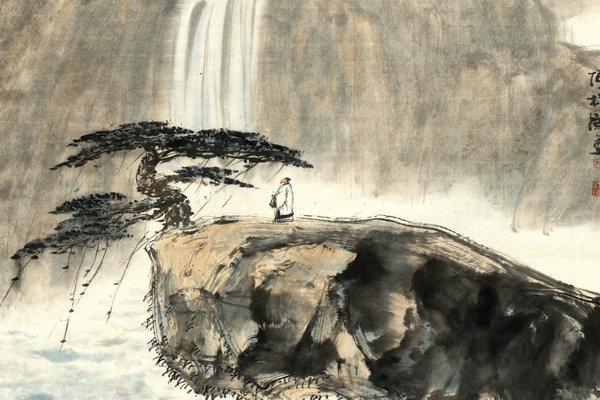
The parable of the Useless Tree by Zhuangzi or Chuang Tzu (369 BC – 286 BC), is an amusing and paradoxical story. It illustrates the limitations of looking at the world in a utilitarian way and the true value of being ‘useless’.
The Paradox of Being Useful by being Useless
In one version of the story, a travelling carpenter named Shih comes across an oak tree of immense size. Its trunk was so large it could hide an ox. Its smallest branches were large enough to be made into boats. A crowd had gathered to look at it, but the carpenter ignored it and walked on. His apprentice also stopped to look, struck by its great size and wonderful timber. He runs after his master and asks why he did not stop to look at it. The master tells him:
“It’s good for nothing. Make a boat of it,—’twould sink. A coffin,—’twould rot. Furniture,—’twould soon break down. A door,—’twould sweat. A pillar,—’twould be worm-eaten. It is wood of no quality, and of no use. That is why it has attained its present age.” (Ch. 4, Zhuangzi, Wade-Giles trans.)
Later, when the Carpenter reaches home, the tree appears to him in a dream. It questions him about comparing him with other useful trees. It points out that they are merely used and discarded by the world. However, he is able to live out the full lifespan of his years by being ‘useless’.
“What is it that you compare me with? Is it with the more elegant trees?—The cherry-apple, the pear, the orange, the pumelo, and other fruit-bearers, as soon as their fruit ripens are stripped and treated with indignity. The great boughs are snapped off, the small ones scattered abroad. Thus do these trees by their own value injure their own lives. They cannot fulfil their allotted span of years, but perish prematurely in mid-career from their entanglement with the world around them. Thus it is with all things. For a long period my aim was to be useless. ”
The story highlights the paradox of being useful by being ‘useless’. The useful tree’s are cut down by the carpenter and used for timber to build boats and houses. But the useless tree is can escape harm and live out its true nature.
This relates to the Taoist concept of Naturalism or Ziran (Spontaneity, or “Self-so-ness”), whereby a thing is able to live out its natural state. It is free from outside force, or interference. (See also, Wu Wei, “Non-action” or “Effortless action”).
What is the True Value of Something?
The useless tree has an inherent value as something other than to be used for something beyond itself (i.e. timber). This is exemplified in another version of the story in The ZhuangZi.
A character called Hui Tzu tells Chuang Tzu he has a large tree that is useless and doesn’t know what to do with it. It’s trunk and branches are knotty and gnarled and for this reason no carpenter will look at it. After making his reply, Chuang Tzu suggests the following:
“Now if you have a big tree and are at a loss what to do with it, why not plant it in the domain of non-existence, whither you might betake yourself to inaction by its side, to blissful repose beneath its shade? There it would be safe from the axe and from all other injury; for being of no use to others, itself would be free from harm.” (Chapter 1, Chuang Tzu, Wade-Giles Trans).
The parable of the useless tree is a recurring Taoist image and a profound metaphor for the value of ‘simply being’. It is a critique of the utilitarian perspective (gain and loss) and aims, using paradox, to show the limits of such a perspective in life.
Sources:
- Chuang Tzu: Mystic, Moralist and Social Reformer, Trans. Herbert Allen Giles, Project Gutenberg eBook, 2019. https://www.gutenberg.org/files/59709/59709-h/59709-h.htm
Leave a Reply